Commercial Kitchen Deep Cleaning: Removing Stubborn Grease
How to remove grease buildup and stubborn residue in restaurant and cafe commercial kitchens.
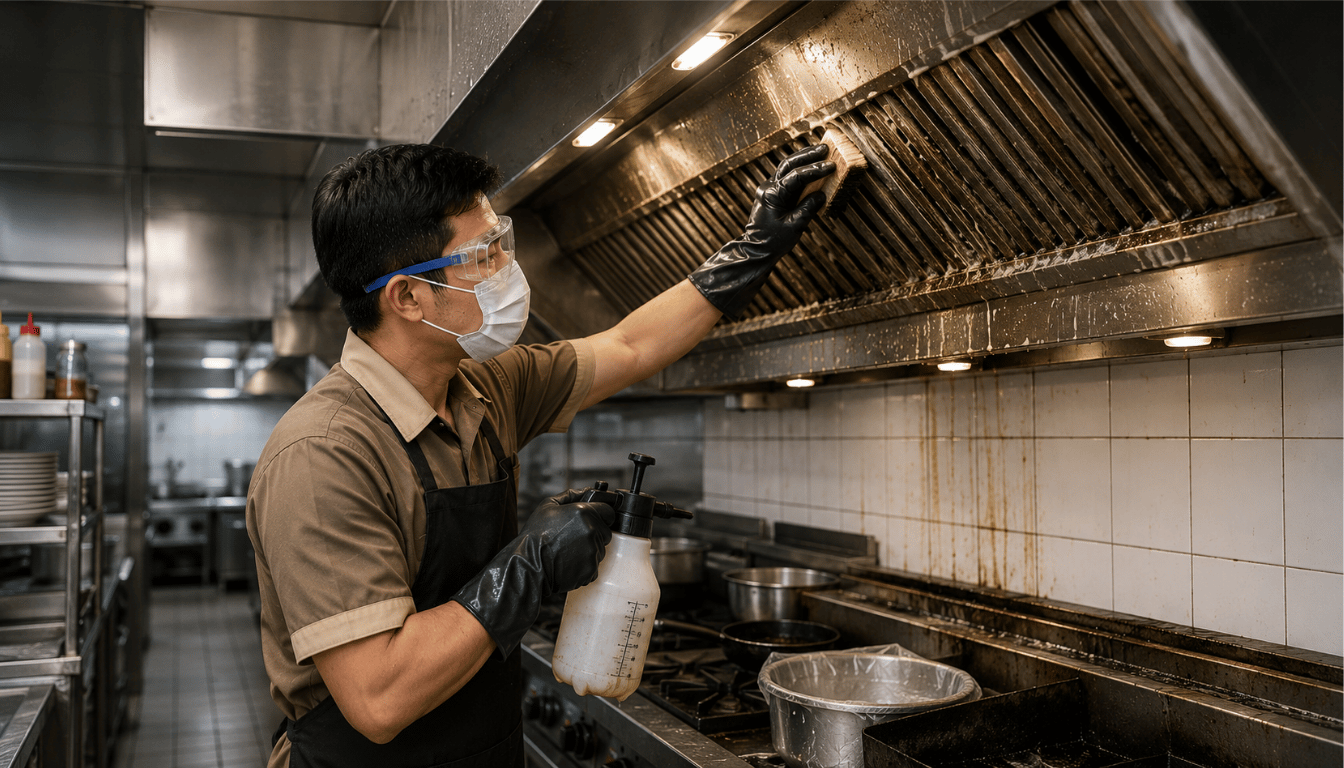
Grease buildup and stubborn baked-on residue in a commercial kitchen are removed through a staged deep-cleaning process that combines specialized degreasing solutions, mechanical scraping for hardened areas, and a thorough clean of the exhaust hood, drainage channels, and cooking equipment surfaces. Without regular treatment, grease buildup can become a fire risk and a hygiene-standard violation that directly affects a restaurant or cafe's operations — and one that's often invisible until an inspection or an incident forces the issue.
1. Why Grease and Baked-On Residue Resist Ordinary Cleaning
A commercial kitchen operates at a far higher cooking intensity than a home kitchen, so oil vapor and grease particles spread more widely across surrounding surfaces — including walls, the ceiling above cooking stations, and the inside of exhaust hoods. Grease that settles and is repeatedly exposed to heat gradually hardens into a crust that no longer dissolves with ordinary dish soap and water.
Daily cleaning with a cloth and dish soap is fine for worktops and frequently-touched equipment, but it doesn't reach hidden spots like the inside of an exhaust hood, gaps under heavy equipment, or floor drains where grease accumulates over time [Insert reference to the relevant commercial kitchen hygiene standard, e.g. local food safety guidelines]. Over weeks and months, these hidden spots become the areas that quietly determine whether a kitchen passes a hygiene inspection.
2. The Real Risks of Letting Grease Build Up
Leaving grease buildup untreated isn't just a matter of an untidy-looking kitchen. There are several real operational risks restaurant and cafe owners should understand:
- Fire risk — grease that accumulates in exhaust hoods and ventilation ducts is flammable material, especially when repeatedly exposed to high heat from stoves or grills. This is one of the most commonly reported causes of kitchen fires in the food and beverage industry.
- Hygiene standard violations — a crust of grease stuck to kitchen surfaces can be a red flag during a hygiene audit, whether from a corporate client, a building landlord, or an inspection visit, with potential knock-on effects for reputation and lease continuity.
- Reduced equipment performance — grease buildup on an exhaust fan can reduce air circulation efficiency, making the kitchen feel hotter and more humid for staff working in it, while also accelerating wear on the exhaust fan's mechanical components.
- Persistent bad odor — grease decomposing in a drain or hidden gap can create a smell that's hard to remove with air freshener alone, and can potentially drift into a customer dining area in restaurants with an open floor plan.
Spots Most Often Missed in Daily Cleaning
Areas commonly missed in a kitchen staff's daily cleaning routine include the inside and outside of the exhaust hood, the grease filter within the ventilation system, gaps between heavy equipment that's rarely moved, and the floor gutter drains that carry water and grease away from the cooking area.
3. How TUM Clean Handles Commercial Kitchen Deep Cleaning
Method and Process Stages
TUM Clean, operated under the legal entity PT. Tunggal Utama Makmur and based in Sentul, Kecamatan Babakan Madang, Kabupaten Bogor, handles commercial kitchen deep cleaning for restaurants and cafes across Bogor, Sentul, Ciawi, Cibinong, Cibubur, and Depok. The process generally follows these stages:
- Initial degreasing using a specialized grease-dissolving solution sprayed onto crusted surfaces to soften the buildup before removal.
- Mechanical removal for areas with thick buildup, using tools such as scrapers or dedicated brushes, particularly for the inside of the exhaust hood and grill surfaces.
- Cleaning ducts and filters, including the exhaust fan's grease filter and floor gutter drains, to make sure ventilation and drainage stay free of grease blockages.
- Final rinse and inspection to confirm no cleaning-chemical residue is left on any food-contact surface.
Kitchen deep-cleaning frequency is typically matched to a client's cooking intensity — a high-volume restaurant needs more frequent treatment than a cafe with a limited menu, and the schedule is adjusted after the first few visits once actual grease accumulation patterns become clear.
Common Mistakes in Commercial Kitchen Cleaning
Some frequent mistakes that make grease buildup worse over time include:
- Only cleaning visible surfaces, while the inside of the exhaust hood and ventilation ducts go untreated for extended periods.
- Using cleaning agents not suited for food-contact surfaces, which risks leaving harmful residue if not rinsed thoroughly.
- No written deep-cleaning schedule, so treatment only happens reactively once staff notice a smell or complaint.
- Grease filters rarely replaced or washed, even though a clogged filter actually speeds up grease buildup in the ventilation ducts.
Grease Trap Maintenance That's Often Overlooked
Beyond the exhaust hood and ventilation, the grease trap on a kitchen's drainage line is another spot that's often overlooked, despite its role in keeping grease out of a building's shared drainage system. A grease trap that's rarely emptied can cause blockages, an odor rising back into the kitchen, and in some cases complaints from building management about the shared drainage system. Periodic inspection and emptying of the grease trap should be part of the kitchen deep-cleaning schedule, rather than handled separately as an emergency call once a blockage already exists.
4. When Restaurants and Cafes Should Schedule Kitchen Deep Cleaning
Beyond the regular periodic schedule, a few conditions signal that a commercial kitchen needs deep cleaning sooner than usual:
- A persistent bad odor appears even though daily cleaning has been done routinely.
- The exhaust hood feels noticeably harder to wipe down than usual, signaling a thick grease crust has built up.
- A hygiene audit from a corporate client, building landlord, or a food-safety inspection visit is coming up.
- Air circulation in the kitchen area has visibly dropped, making the room feel hotter than usual.
As a general illustration, high-volume kitchens such as restaurants with a grill or fried-food menu should deep clean more often than a cafe with a limited menu and minimal hot-oil use. The exact schedule still needs to be matched to each kitchen's operating conditions [Insert specific frequency recommendation based on a site survey and menu type], since two kitchens of similar size can accumulate grease at very different rates depending on what's actually being cooked.
To get a kitchen deep-cleaning schedule matched to your restaurant or cafe's operational volume, please Contact Us or read Articles on specialist and project cleaning.
FAQ
Quick and Practical Consultation
Address
Darmawan Park, Jl. Babakan Madang No.99, Sentul, Kec. Babakan Madang, Kabupaten Bogor, Jawa Barat 16810
Google Maps